
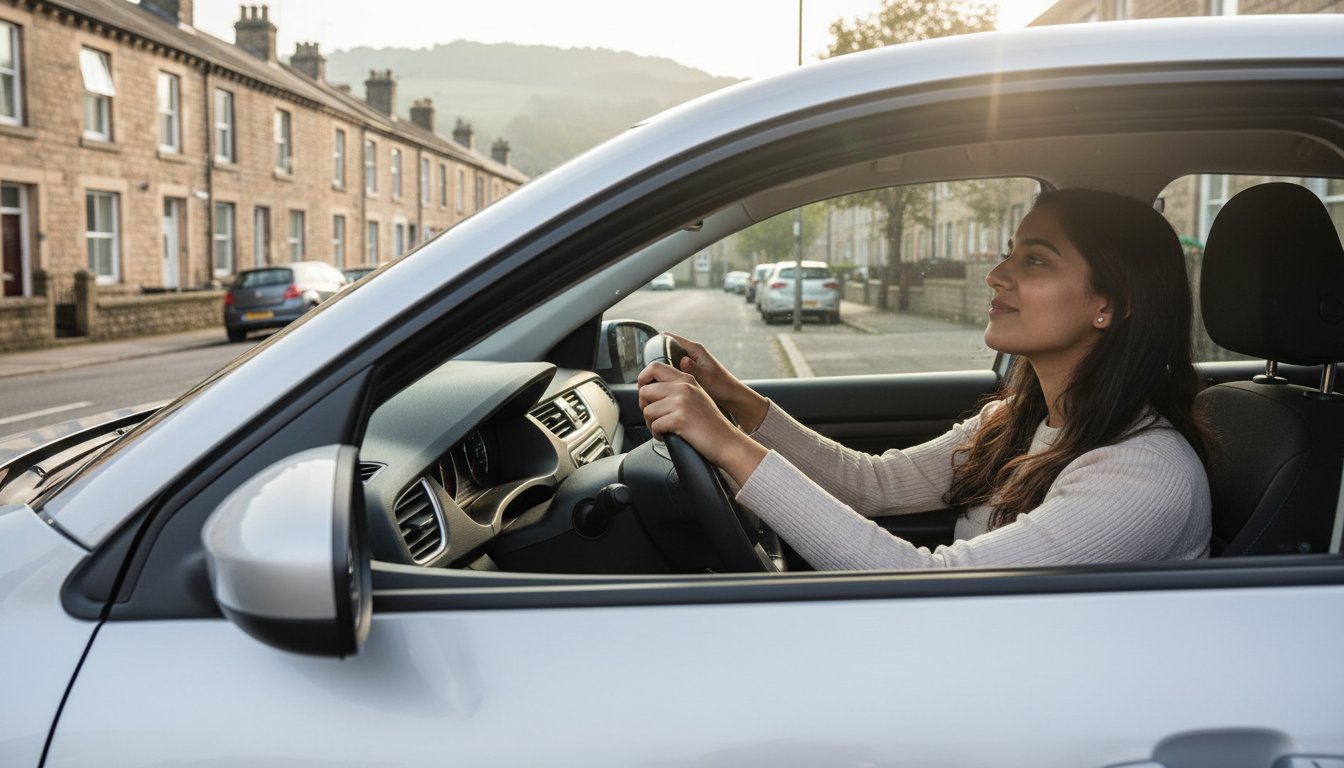
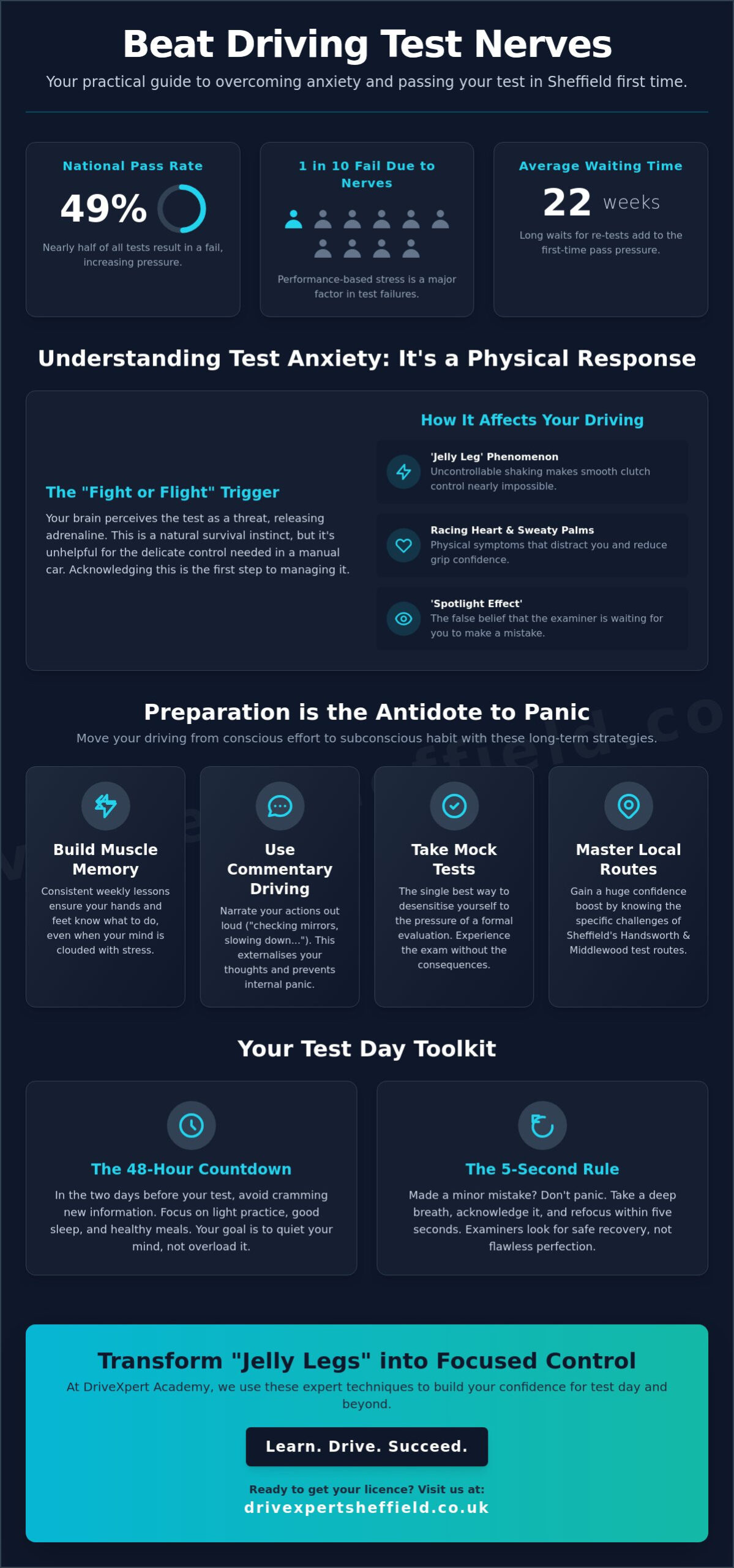
You are sitting at the Handsworth or Middlewood test centre, your left leg is shaking uncontrollably on the clutch, and the examiner has just picked up their clipboard. It is a paralysing moment that many learners face, especially with the national average pass rate currently at 49 per cent. With waiting times averaging 22 weeks as of September 2025, the pressure to pass first time can feel overwhelming. You are likely wondering how to overcome driving test anxiety UK while facing the very real fear of stalling your manual car in front of an official.
At DriveXpert Academy, we know that simply “trying to relax” is rarely enough. We promise to help you transform those “jelly legs” into focused control through professional simulation-led exposure and tailored local insights. You will discover how to handle mistakes without spiralling and gain the confidence needed to master Sheffield’s specific test routes. This guide previews the exact techniques we use in our mock driving tests to ensure you feel comfortable, prepared, and ready to earn your licence. Learn. Drive. Succeed.
Key Takeaways
- Understand how adrenaline physically impacts your clutch control and why 1 in 10 learners fail due to performance-based stress.
- Discover how “Commentary Driving” during your manual lessons builds the subconscious habits needed to stay calm under pressure.
- Learn practical strategies for how to overcome driving test anxiety UK, including a strict 48 hour countdown to quiet your mind.
- Master the “Five Second Rule” to recover from minor mistakes on the day without letting your nerves spiral out of control.
- Gain a localised advantage with expert tips for navigating the specific challenges of Sheffield’s Handsworth and Middlewood test routes.
Understanding Driving Test Anxiety: Why 1 in 10 UK Learners Fail Due to Nerves
Driving test anxiety is not a sign of weakness; it is a natural performance-based stress response. When you sit in that driver’s seat, your brain perceives the examiner’s clipboard as a significant threat. This triggers a “fight or flight” response, flooding your system with adrenaline. While this biological surge was designed to help our ancestors escape danger, it is incredibly unhelpful when you are trying to master the delicate bite point of a manual car. Learning how to overcome driving test anxiety UK starts with acknowledging that your body is simply trying to protect you. The physical symptoms, such as a racing heart or sweaty palms, are just misplaced energy.
Many learners also struggle with the ‘Spotlight Effect’. This is the overwhelming feeling that the examiner is a hawk, watching every tiny movement specifically to find a reason to fail you. In reality, examiners are trained to look for safety and competence, not perfection. If you feel nervous, take it as a positive sign. It proves you care about being a safe driver and respect the responsibility of holding a full UK driving licence. We see this often at DriveXpert Academy, and we focus on turning that nervous energy into calm, focused observation. Understanding what is test anxiety helps you realise that your brain is just reacting to a high-stakes environment.
The Difference Between Nerves and Not Being Ready
It is vital to distinguish between simple ‘test jitters’ and a genuine lack of skill. If you still rely on your instructor to tell you when to change gear or check your blind spots, you likely aren’t ready for the exam. The DVSA ‘Ready to Pass’ criteria provide a clear benchmark for baseline confidence. When you meet these standards, your skills are solid enough to pass, even if your mind feels shaky. Attempting the test too early is the primary fuel for anxiety. It creates a fear of the unknown because you haven’t yet mastered the vehicle. We ensure our students are consistently driving without intervention before they ever book a slot.
How Anxiety Affects Manual Car Control
Manual drivers face a specific challenge known as the ‘Jelly Leg’ phenomenon. Under intense stress, your left leg can tremble, making smooth clutch control nearly impossible during hill starts or stop-start traffic. This physical shake often leads to a fear of stalling, which then triggers more panic. Within the context of UK driving standards, performance anxiety is the psychological pressure of demonstrating complex physical coordination while being evaluated against strict safety regulations. Because manual cars require more physical input than automatics, the pressure to perform can feel doubled. We use mock driving tests to desensitise you to this pressure, making the movements feel like second nature. Learn. Drive. Succeed.
Long-Term Preparation: Building ‘Test-Day Muscle Memory’
Preparation is the ultimate antidote to panic. Building a solid foundation is the most effective way for how to overcome driving test anxiety UK because it moves your driving from conscious effort to subconscious habit. When you don’t have to think about which gear to select or how to find the bite point, your brain has more capacity to manage nerves. We recommend consistent weekly lessons to ensure your skills stay sharp. This regularity helps you develop “muscle memory,” meaning your hands and feet know exactly what to do even when your mind feels clouded by stress.
We encourage “Commentary Driving” during our manual lessons to help you stay grounded. This involves narrating your actions out loud, such as “checking my centre mirror, slowing down for the roundabout, selecting second gear.” By externalising your thoughts, you prevent internal panic from spiralling into a mistake. This technique is particularly useful when navigating complex Sheffield road layouts like the Park Square roundabout. We focus on these specific junctions early on to remove the “fear of the unknown.” When you know the road, you can focus entirely on your safety and observation. Following expert driving test tips regarding route familiarisation can significantly lower your heart rate on the day.
The Power of the Mock Driving Test
A formal mock test is the best way to desensitise yourself to the pressure of the exam. We often arrange for a different instructor to conduct these, simulating the formal atmosphere you will encounter at the Handsworth or Middlewood centres. One of the biggest shocks for learners is “examiner silence.” During a normal lesson, your instructor provides constant feedback and encouragement. In a test, the examiner is mostly quiet. Our mock driving tests prepare you for this lack of feedback, helping you stay focused without needing external validation. If you “fail” a mock test, don’t worry. We use those points as a constructive roadmap for your final lessons, refining exactly what needs work before the real event.
Mastering the ‘Show Me, Tell Me’ Questions Early
Nailing the safety questions at the start of the test sets a positive, confident tone for the rest of the drive. If you struggle with the technical details, start your preparation weeks in advance so the answers become second nature. We help you create a “pre-drive ritual” in our Volkswagen Golfs, from adjusting your seat to checking your mirrors. This routine helps you settle into the cockpit and feel in control before the engine even starts. For more detailed advice on starting your journey, check out our guide on Driving Lessons Sheffield: Your Expert Guide to Passing First Time in 2026. Mastering these basics early ensures you begin your test with a “win,” giving you the momentum needed to succeed. Learn. Drive. Succeed.
The 48-Hour Countdown: Practical Prep to Quiet the Mind
The two days leading up to your driving test are about protecting your headspace and reducing external friction. This window is the most effective time to implement strategies for how to overcome driving test anxiety UK by focusing on what you can control. Start by implementing a strict “no-caffeine” rule. Whilst a morning coffee feels like a necessity, stimulants and high adrenaline are a dangerous mix. They can turn a slight tremor into full “jelly legs” on the pedals. Stick to water or herbal tea to keep your heart rate steady and your mind clear. Maintaining a sense of normality is essential; don’t treat the exam like a life-altering event; treat it as just another drive in our Volkswagen Golf.
Physical organisation prevents last-minute panic. Lay out your provisional licence and theory test certificate 24 hours in advance. Searching for a lost document ten minutes before your instructor arrives is a guaranteed way to spike your cortisol levels. Once your bag is packed, spend twenty minutes on visualisation. Close your eyes and “drive” through the Handsworth or Middlewood test routes in your mind. Picture yourself successfully navigating the tricky junctions we’ve practised. This mental rehearsal builds a sense of familiarity, making the actual test feel like a repeat performance rather than a new challenge.
Nutrition and Hydration for Focus
Your brain needs steady fuel to maintain the concentration required for a 40-minute drive. Choose slow-release carbohydrates for breakfast, such as porridge or wholemeal toast, to prevent energy crashes. You might have heard about the “Banana Myth” from other learners. It is a popular pre-test tradition because bananas are rich in potassium and vitamin B6, which help regulate the nervous system. Whether it’s a placebo or a nutritional boost, 1 in 3 of our successful students swear by it. Balance your hydration carefully; you want to be alert but comfortable throughout the duration of the exam.
Logistics and Planning
Timing is everything when you are managing nerves. Plan to arrive at the Sheffield test centre exactly 10 to 15 minutes before your slot. Arriving too early means sitting in the waiting room and “stewing” on your anxiety, while arriving late creates unnecessary stress. Wear comfortable, flat footwear that provides a good feel for the pedals. Avoid heavy boots or brand-new shoes that might slip. We always recommend a one-hour lesson immediately before the test. This warm-up settles your nerves, confirms the car is handling perfectly, and gets you into the “driving flow” before the examiner even opens their door. Learn. Drive. Succeed.
On-the-Day Tactics: Managing Nerves Behind the Wheel
Once the examiner joins you in the car, the atmosphere shifts. It is easy to feel like you are being judged under a microscope, but reframing this perspective is vital for success. View the examiner as a “safety observer” rather than a judge. Their primary goal is to ensure you can navigate the road without putting yourself or others at risk. Learning how to overcome driving test anxiety UK involves mastering your immediate environment inside the vehicle. If you don’t understand a direction, simply ask them to repeat it. They won’t penalise you for seeking clarity; in fact, it shows you are composed and prioritising safety over guesswork.
Use red traffic lights as opportunities to reset your nervous system. Instead of staring at the light and gripping the wheel, try box breathing. Inhale for four seconds, hold for four, exhale for four, and hold again. This simple technique physically lowers your heart rate and breaks the cycle of panic. The 40-minute test duration, which includes roughly 20 minutes of independent driving, requires sustained focus. These small moments of “active rest” at junctions keep your mind sharp and your movements fluid.
Recovering from a Stall in a Manual Car
Stalling is the number one fear for manual learners, yet it is rarely an automatic fail. The danger isn’t the stall itself; it is the panicked reaction that follows. If the engine cuts out, apply the “Five-Second Rule” to reset your composure. Follow these steps to demonstrate control:
- Secure the car immediately with the handbrake.
- Select neutral and restart the engine.
- Take a deep breath and perform a full 360-degree observation.
- Re-select your gear and move off when it’s safe.
A stall is usually recorded as a minor driving fault unless it happens in a dangerous location or you fail to re-observe before moving off. Keep your eyes up and focused on the road. Looking down at the gear stick when stressed is a common habit that leads to steering veering or missed hazards. Stay focused on the windscreen, not the floor.
Dealing with the ‘Internal Monologue’
If you clip a kerb or hesitate at a junction, your internal monologue might tell you the test is over. This is the moment to “bin it” mentally. You cannot change what happened 30 seconds ago, but you can control the next metre of road. Focus entirely on the immediate task. Using positive self-talk during the independent driving section helps anchor your focus on the road ahead rather than the pressure of the assessment. The DriveXpert mindset is about resilience. We teach our students that one mistake doesn’t define the drive. To practice these recovery techniques in a realistic environment, you can book a mock driving test to build your on-road confidence. Learn. Drive. Succeed.
The DriveXpert Academy Approach: Sheffield’s Confidence Partners
At DriveXpert Academy, we believe that technical skill is only half the battle. Many learners know how to operate the vehicle but struggle with the “confidence gap” that appears under pressure. Our tailored manual tuition is specifically designed for how to overcome driving test anxiety UK by creating a supportive environment where mistakes are seen as learning opportunities. We use modern Volkswagen Golfs because their controls are intuitive and forgiving. This makes finding the bite point or navigating gear changes feel less daunting during those critical 40 minutes with an examiner. We don’t just teach you to pass; we teach you to feel in control.
We act as your “Success Partner” throughout this journey. This means we won’t push you toward the earliest available test date just to clear our books. We only recommend you sit the exam when your mock test results show you are truly ready. This honesty prevents the psychological blow of a premature fail, which is often a major trigger for long-term driving anxiety. Our instructors are patient, adaptable, and invested in your success. We understand that everyone learns at their own pace, and our goal is to build a foundational level of skill that makes the test feel like a formality.
Why Local Knowledge Matters
Sheffield is famous for its hills and unique road layouts. If you can drive here, you can drive anywhere. We familiarise you with the specific challenges of the Handsworth and Middlewood test centres. From the steep gradients requiring perfect hill starts to the fast-moving A-roads, we ensure no part of the route is a surprise. Our instructors provide personalised feedback loops that target your specific anxiety triggers, whether it’s a particular roundabout or a specific manoeuvre. This localised expertise ensures you are never “caught out” by a tricky junction on the day of your exam.
Let’s Get You on the Road
Whether you choose our intensive driving courses or a block of 10 lessons, our goal is to reduce the pressure of the learning process. We break down complex skills into manageable steps, ensuring you feel comfortable at every stage. We have helped hundreds of students turn their “jelly legs” into driving confidence. Our approach to how to overcome driving test anxiety UK focuses on psychological readiness alongside physical skill. Our triadic mantra is simple: Learn. Drive. Succeed. You have already put in the hard work and refined your skills. Now, it’s time to show the examiner the safe, competent driver you have become. Let’s get you on the road.
Ready to Transform Your Driving Future?
Transitioning from a nervous learner to a licensed driver is a journey of both skill and mindset. By implementing the simulation techniques and on-the-day tactics discussed, you now have a clear roadmap for how to overcome driving test anxiety UK. Remember that your examiner is simply there to ensure road safety, and every minor mistake is an opportunity to demonstrate your resilience and composure behind the wheel.
At DriveXpert Academy, we are committed to providing the supportive environment you need to thrive. Our DVSA-registered professional instructors use modern manual Volkswagen Golfs equipped with dual controls to ensure you feel secure whilst refining your skills. With our high first-time pass rates across Sheffield test centres, we have the local expertise to help you move from a complete novice to a successful, independent driver.
Book your confidence-building manual lessons with DriveXpert Academy today and let’s turn your test-day nerves into focused driving confidence. You have the ability; now let’s show the examiner. Learn. Drive. Succeed.
Frequently Asked Questions
Can I take rescue remedy or herbal calmers before my driving test?
You can use herbal remedies like Bach Rescue Remedy, but you must ensure they do not cause drowsiness or affect your reaction times. Always consult a pharmacist at least 48 hours before your appointment to confirm any product is safe for use while driving. If you are concerned about side effects, we recommend sticking to the box breathing techniques we practice during our manual lessons to keep your heart rate steady naturally.
What happens if I cry or get too upset during the driving test?
If you become overwhelmed, you are allowed to ask the examiner for a moment to compose yourself. Pulling over safely to take a breath is not an automatic fail, provided you maintain full control of the vehicle and perform the stop legally. Examiners are very used to high emotions; they will often wait a minute whilst you settle your nerves so you can continue the drive safely.
Should I tell people when my driving test is or keep it a secret?
Keeping your test date a secret is a brilliant way to reduce the “social pressure” that fuels nerves. Roughly 60 per cent of learners find that telling fewer people makes it easier to manage how to overcome driving test anxiety UK. By only informing your instructor, you don’t have to worry about explaining the result to friends or family, which allows you to focus entirely on your own performance.
Is it normal for my leg to shake on the clutch during the test?
Physical tremors, or “jelly legs,” are a very common response to the adrenaline surge of a test. If your left leg starts to shake, use your handbrake at every red light or junction to give your muscles a chance to rest. This prevents the tremor from interfering with your clutch control and gives you a moment to reset your focus before you need to find the bite point again.
How many minors can I have before I fail the driving test UK?
You are permitted a maximum of 15 driving faults, commonly known as “minors,” during your practical exam. However, if you commit a single serious or dangerous fault, you will not pass. It is worth remembering that the average successful candidate still records around 5 to 7 minors, so don’t panic if you feel you have made a small mistake during the drive.
What should I do if I think I’ve already failed five minutes into the test?
You must continue driving as if you are still on track for a pass. Many learners mistake a minor fault for a serious one and give up mentally, only to discover later they were still in the running. Data suggests that 10 per cent of candidates who were convinced they had failed actually received a pass certificate because their “major” mistake was only recorded as a minor.
Can I listen to music during my driving test to stay calm?
You are not permitted to listen to your own music or use headphones because you need to hear the examiner’s instructions and ambient road sounds. However, you can ask the examiner to have the car radio on low if it helps you feel more comfortable. Most students find that silence is better for concentration, but the choice is yours as long as it isn’t a distraction.
Is the examiner allowed to talk to me during the drive?
Examiners are allowed to engage in light small talk to help put you at ease during the drive. Whilst they cannot give you any help or hints regarding your driving, they are human and often try to create a relaxed atmosphere. If you find conversation distracting, it is perfectly acceptable to politely tell them that you would prefer to focus on the road in silence. Learn. Drive. Succeed.
Comments are closed