
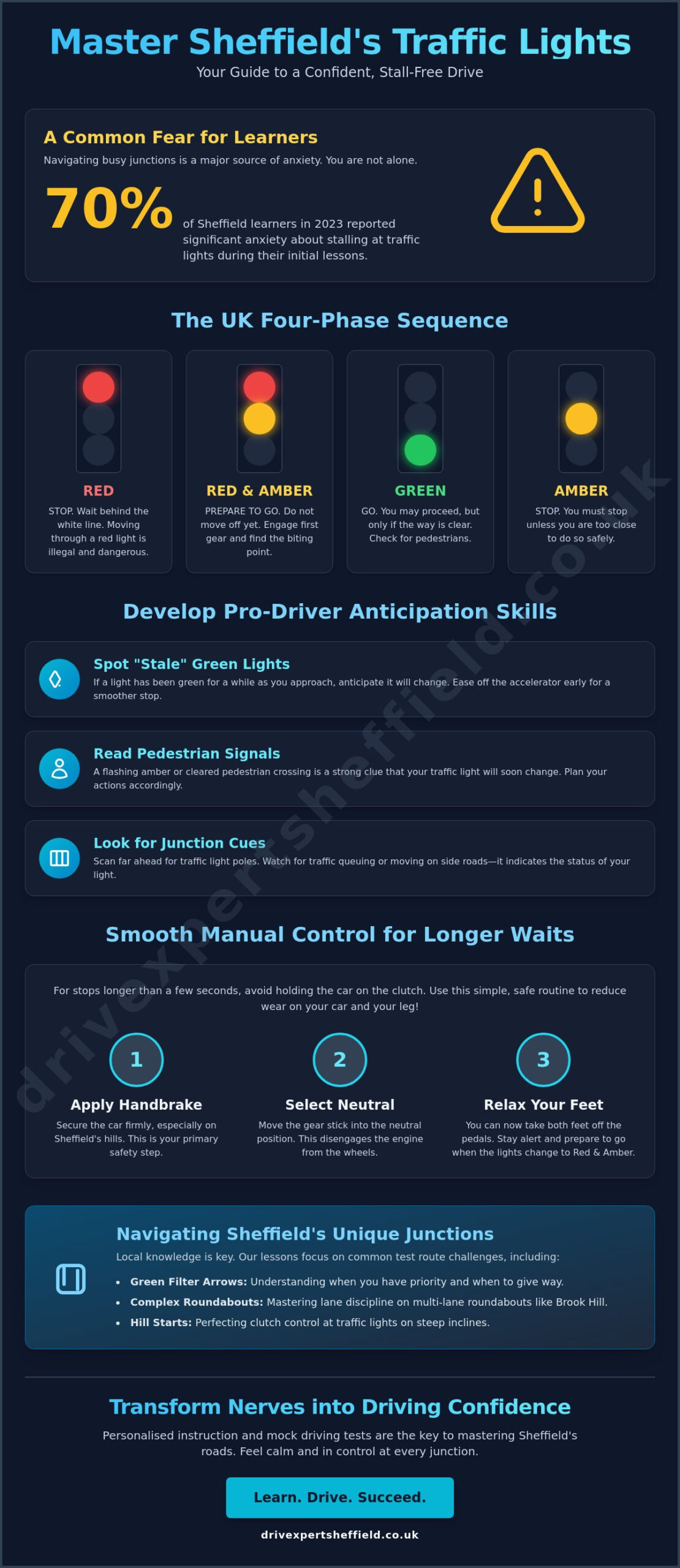
Imagine you are waiting at the front of the queue at the Brook Hill roundabout during the 17:00 rush. The red light glows, your foot is hovering over the clutch, and you are convinced that the engine will stall the second you try to move. For many, navigating traffic light traffic in a hilly city like Sheffield feels more like a high-stakes performance than a simple commute. It is a common fear, with roughly 70% of local learners in 2023 reporting significant anxiety about stalling at busy junctions during their first ten hours of lessons.
We know that the pressure of a queue behind you or the confusion of a sudden filter arrow can be overwhelming. You deserve to feel calm and in control every time you approach the lights. This guide will teach you to decode the UK sequence perfectly whilst refining the essential car control skills needed for smooth getaways. We will break down the amber “dilemma zone” and explain those complex Sheffield roundabouts so you can approach your practical test with total confidence. Let’s get you on the road. Learn. Drive. Succeed.
Key Takeaways
- Master the four-phase UK sequence and understand the legal requirements for stopping safely on Sheffield’s busy roads.
- Develop advanced anticipation skills by learning to spot “stale green” lights and reading the flow of vehicles far ahead of you.
- Refine your manual car control to handle traffic light traffic smoothly using the essential handbrake-neutral routine during longer waits.
- Navigate complex Sheffield junctions and green filter arrows with confidence by identifying common local test route traps.
- Discover how personalised instruction and mock driving tests can transform your nerves into expert road safety awareness.
The UK Traffic Light Sequence: Understanding the Logic on Sheffield Roads
Driving through Sheffield’s bustling streets requires more than just steering skills. It’s about mastering the rhythm of the road. Whether you’re navigating the busy junctions in Heeley or heading through the heavy traffic light traffic toward the City Centre, understanding the logic behind every signal helps you build the confidence needed to succeed. Our goal is to turn every learner into a safe, thinking driver who understands the “why” behind the rules.
The UK follows a specific four-phase pattern designed to keep everyone moving safely. While global traffic light systems vary in their timings and transitions, our local roads rely on a predictable cycle to manage vehicle flow. Mastering this sequence is a foundational part of your journey. Let’s get you on the road by breaking down exactly what happens when the lights change.
Learn. Drive. Succeed.
The Meaning of Each Colour Phase
Every phase in the UK sequence has a clear legal definition. We focus on these details during our personalized lessons to ensure you’re fully prepared for your test and beyond.
- Red: This is a non-negotiable stop. You must wait behind the white stop line. In 2023, UK road safety data highlighted that jumping red lights remains a leading cause of avoidable urban collisions.
- Red and Amber: This phase tells you to prepare. You shouldn’t move whilst this is showing. Wait until the light turns green before you release the handbrake and find your biting point.
- Green: You may proceed if the way is clear. It’s essential to perform a quick scan for pedestrians or cyclists who might still be finishing their crossing before you move off.
- Amber: This signal appears alone after green. It means you must stop unless you’re so close to the line that stopping would cause an accident.
The Amber Light Dilemma
One of the most common anxieties for new drivers is deciding whether to stop or go when a light turns amber. Highway Code Rule 175 is very clear: you must stop at the amber light unless you’ve already crossed the stop line or are so close to it that pulling up sharply might cause a rear-end collision. We help you refine your speed and observation skills so you can make this decision calmly.
Abruptly slamming on the brakes is a risk. If a vehicle is following you closely, a sudden stop can lead to a crash. To drive safely, you must identify the “dilemma zone,” which is the specific point on the road where stopping safely is impossible due to your current speed and distance from the signal. By anticipating changes in traffic light traffic, you can avoid being caught out. We use mock driving tests to practice these real-world scenarios, ensuring you feel comfortable and in control at every Sheffield junction.
Anticipation and Planning: Reading the Traffic Flow
Mastering traffic light traffic starts with where you point your eyes. Don’t just stare at the bumper of the car in front; look through their rear window or around their chassis to spot the lights early. This long-range scanning allows you to identify a “stale green” light. If a light has been green since you first saw it, it’s highly likely to change as you approach. We’ll teach you to ease off the gas early, which saves your brake pads and keeps your drive smooth. Learn. Drive. Succeed.
Pedestrian signals offer another vital clue for your planning. If the “red man” is lit, the traffic flow is usually stable; however, a flashing amber or a cleared crossing often signals an imminent change for motorists. Understanding these patterns is a core part of the official Highway Code, which every learner should know by heart. By spotting these hints 100 metres before the junction, you can start your MSM (Mirror, Signal, Manoeuvre) routine before the car behind even knows there’s a stop coming.
Early Observation Techniques
In busy Sheffield traffic, spotting the upright poles amongst the sea of shop signs and street furniture is a vital skill. Look for the black and white striped poles at least 10 seconds before you reach them. Watch the side roads too. If you see vehicles beginning to queue at a side junction, it’s a sign that their light is red and yours is currently green. If their “waiting” traffic starts to move, your light will change almost immediately. Adjusting your speed by just 5mph early can often mean the difference between a smooth roll-through and a jerky, fuel-wasting stop.
Managing the Car Behind You
Managing traffic light traffic effectively requires constant vigilance of your surroundings. Your interior mirror is your best friend when approaching signals. Check it the moment you see a light change to assess how close the following driver is. If they’re tailgating, a gradual slow-down is much safer than a sudden halt. Signalling your intentions early helps other Sheffield road users plan their own journey, which reduces the risk of a rear-end collision.
It’s easy to feel pressured by impatient drivers at Meadowhead or Handsworth, but staying calm is essential for safety. Focus on your own technique and don’t let their behaviour dictate your speed. We’ll help you refine your confidence so you never feel rushed by the car behind. Let’s get you on the road with the skills to handle any junction with ease.
Mastering the Manual Gearbox at Traffic Lights
Managing a manual gearbox during traffic light traffic is a foundational skill that separates a nervous learner from a confident driver. It is about more than just stopping; it is about maintaining total control of the vehicle at all times. Many learners fall into the trap of “coasting,” which involves keeping the clutch depressed or staying in neutral whilst the car is still moving. This habit is dangerous because it removes engine braking and reduces your ability to steer or accelerate away from a hazard quickly. If you’re just starting out, our driving lesson guide for Sheffield beginners in 2026 covers everything you need to know before your first hour behind the wheel. Learn. Drive. Succeed.
Stopping and Securing the Vehicle
When you see a red light ahead, begin by easing off the accelerator and braking progressively. You should only dip the clutch when your speed drops significantly, usually just before the engine starts to vibrate at around 10 mph. Once you have come to a complete halt, apply the handbrake immediately. This is a vital safety step, particularly on the steep 15% gradients found throughout Sheffield, where even a tiny roll-back can lead to a collision. After securing the handbrake, move the gear stick into neutral and release the clutch. This routine protects the car’s release bearing and gives your left leg a much-needed rest during long waits.
Moving Off Under Pressure
Preparation is the key to a prompt, stress-free start when dealing with traffic light traffic. As you observe the cross-traffic slowing down, prepare yourself by selecting first gear. According to the official UK Highway Code on traffic signals, the Red and Amber phase means you must wait for the green light before crossing the line, but this is your cue to find the biting point. In our DriveXpert Volkswagen Golf, you will feel a slight dip in the engine note and a gentle tug as the clutch plates meet.
Coordinate your feet by applying a small amount of gas as you slowly release the clutch. If the engine stalls, keep your cool. Simply press the footbrake, dip the clutch, and restart the ignition. The drivers behind you were learners once too, so take a breath and reset. “Mechanical sympathy is the hallmark of a great driver; by treating the clutch with patience and precision, you ensure a smooth ride for your passengers and longevity for your vehicle.” Let’s get you on the road with the skills to handle any junction with ease.
Navigating Complex Sheffield Junctions and Filter Arrows
Sheffield’s hilly terrain and historic layout create some of the most challenging junctions in South Yorkshire. Mastering these areas isn’t just about knowing when to go; it’s about anticipating how different streams of vehicles interact. Managing traffic light traffic in a busy city centre requires total focus and a solid understanding of local road layouts. Our goal is to help you feel composed, even when the road ahead looks like a maze of signals and sensors.
Filter Arrows and Lane Discipline
Filter arrows are designed to keep Sheffield moving, but they often trip up learners during their practical tests. If the main light is green but the right-turn filter arrow remains off, you can usually move into the junction to wait for a gap in oncoming traffic. You must stay behind the stop line if that specific arrow is red. At the Brook Hill roundabout, you’ll encounter five different exits and a complex sequence of lights. Success here depends on early lane selection. If you find yourself in the wrong lane at Park Square, don’t try to force a late change. It’s safer to follow the lane you’re in and find a way to turn back later. This approach protects your safety and prevents “serious” faults on your test report.
- Wait for the arrow: If a dedicated green arrow illuminates, you have right of way to turn.
- Check the exit: Never enter a junction if your exit isn’t clear, even on a green light.
- Stay central: When waiting to turn right at a filter, keep your wheels straight so you aren’t pushed into oncoming traffic if hit from behind.
Tram Signals and Shared Spaces
The Sheffield Supertram adds an extra layer of complexity to the city’s traffic light traffic. You’ll frequently see white “dot and bar” signals positioned next to standard lights. These are specifically for tram drivers. A horizontal white bar means the tram must stop, whilst a vertical or diagonal bar allows them to proceed. Whilst these don’t dictate your movement, they tell you exactly what the tram next to you is about to do.
Yellow box junctions are another critical area. In Sheffield, local authorities can issue a £70 penalty charge notice for stopping in these boxes. You should only enter the box if your exit is completely clear. The only exception is when you’re turning right and are only blocked by oncoming vehicles or other cars also waiting to turn right. This rule is frequently tested on routes near the Middlewood and Handsworth areas. We’ll help you refine these observations until they become second nature.
Let’s get you on the road with the skills to handle any junction. Book your personalized Sheffield driving lessons today and build the confidence you need to succeed.
Building Confidence with Professional Instruction in Sheffield
Mastering traffic light traffic requires more than just knowing red means stop. At DriveXpert Academy, we turn that theory into practical confidence on the road. Our instructors understand that the leap from a quiet residential street to the multi-lane complexity of the Brook Hill roundabout or the Sheffield Parkway can feel daunting. We bridge that gap with professional, patient tuition designed to turn nervous learners into capable drivers.
We focus on a progressive learning curve. You will start on calmer routes in areas like Dore or Totley to build your basic vehicle handling. Once your confidence grows, we gradually introduce busier environments. This structured transition ensures you aren’t overwhelmed by the fast-paced nature of Sheffield City Centre until you’re truly ready to handle it.
Tailored Lessons for Every Learner
We don’t believe in one-size-fits-all teaching because everyone learns at their own pace. If you find hill starts at a red light on a steep Sheffield incline stressful, we will spend dedicated time on that specific skill. We refine your Mirror-Signal-Manoeuvre (MSM) routine until it becomes an instinctive habit. This foundational work is vital for safety and test success.
DriveXpert Academy provides a top-notch, supportive environment. We uphold rigorous professional standards, ensuring you benefit from comprehensive instruction combined with the dedicated, personalised care of a local instructor. We prioritise your psychological readiness, ensuring you feel comfortable and empowered behind the wheel at every stage of your journey.
Local knowledge is a significant advantage when it comes to the practical test. Our instructors are experts in Sheffield’s specific test routes, including the challenging sections around the Middlewood and Handsworth test centres. We use mock driving tests to replicate the exact conditions of the exam. These sessions are essential for identifying small errors in how you approach traffic light traffic or lane positioning before they become costly mistakes on the big day.
Let’s Get You on the Road
Mastering the logic of traffic lights is a major milestone in your driver training. By understanding how to anticipate light changes and position your car correctly, you remove a significant source of driving anxiety. We are committed to helping you refine these skills until you are a safe, licensed driver ready for any junction the UK roads can throw at you.
- Personalised lesson plans that target your specific weaknesses.
- Flexible scheduling for manual lessons to fit your work or study commitments.
- Intensive courses available for those who want to qualify quickly.
- Expert guidance on both theory and practical test preparation.
Are you ready to gain your independence? Whether you’re a complete novice or looking to polish your skills after a break, we have the expertise to help you reach your goal. Let’s get you on the road today.
Learn. Drive. Succeed.
Take Control of the Sheffield Roads
Mastering traffic light traffic in Sheffield is about more than just knowing when to go; it’s about developing the anticipation and manual control needed for complex junctions like Brook Hill roundabout. By understanding the specific light sequences and refining your clutch control, you turn stressful stops into smooth transitions. Every junction you navigate builds the foundational skills required to pass your test at the Handsworth or Middlewood test centres.
At DriveXpert Academy, we provide a supportive environment to help you refine these essential habits. You’ll learn in a modern manual Volkswagen Golf, guided by DVSA-registered expert instructors who specialise in Sheffield test route preparation. We understand that every learner is individual, so we tailor our approach to ensure you feel comfortable and ready for any challenge the road presents. Let’s get you on the road and help you transform from a novice into a licensed driver.
Learn. Drive. Succeed. Book your manual driving lessons in Sheffield with DriveXpert Academy today and start your journey toward independence with confidence.
Frequently Asked Questions
What does a flashing amber light mean at a pelican crossing?
A flashing amber light means you must give way to any pedestrians who are already on the crossing. If the crossing is completely clear of people, you’re permitted to proceed with caution. This specific phase is unique to pelican crossings and helps maintain a steady flow of traffic light traffic whilst ensuring pedestrian safety. Our instructors focus on this during lessons to build your confidence in busy urban environments.
Can I be fined for crossing a stop line on an amber light in Sheffield?
You can be fined £100 and receive three penalty points for failing to stop at an amber light if it was safe to do so. Under Rule 175 of the Highway Code, amber signals you to stop at the line unless you’ve already crossed it or are so close that stopping might cause an accident. In Sheffield, South Yorkshire Police enforce these regulations strictly to reduce collisions at busy junctions. We’ll help you refine your timing so you always make the safest choice.
What is a green filter arrow and how does it work?
A green filter arrow indicates that you have priority to move in the direction shown, even if the main circular green light isn’t lit. You should proceed confidently whilst remaining observant of other road users. This system helps manage traffic light traffic by creating dedicated windows for turning vehicles. We’ll help you refine your observation skills during your tailored lessons so these signals become second nature. Learn. Drive. Succeed.
Do I have to use the handbrake every time I stop at traffic lights?
You aren’t legally required to apply the handbrake every time, but it’s a foundational habit for safety and control. Using the parking brake prevents your car from rolling if you’re hit from behind; it also ensures your brake lights don’t dazzle the driver behind you at night. If you’re stationary for more than a few seconds, applying the handbrake helps you stay relaxed and ready for the change in signal. Let’s get you on the road with these essential habits.
What should I do if I stall at a green light during my driving test?
If you stall, the most important thing is to remain calm and follow your restart routine quickly and safely. Secure the car with the handbrake, restart the engine, and perform your 360-degree observations before moving off. According to DVSA data from 2023, a single stall usually results in a minor fault rather than an immediate fail, provided you handle it safely without obstructing others. Our mock driving tests are designed to build the psychological readiness you need for these moments.
How do I know if a traffic light has a camera in Sheffield?
You can identify traffic light cameras by looking for small grey or yellow housings mounted on poles near the junction. In Sheffield, the South Yorkshire Safety Camera Partnership operates various digital red-light cameras at high-risk sites like the A61. These devices are often preceded by warning signs featuring a camera icon. Developing good habits and anticipating light changes ensures you always stay within the law. We focus on road safety awareness to make you a top-notch driver.
Can I turn left on a red light in the UK?
You must never turn left on a red light in the United Kingdom unless there’s a specific green filter arrow permitting the movement. Unlike some other countries, a red signal is an absolute command to stop behind the white line. Following this rule is essential for road safety and is a critical part of your theory and practical preparation. We’ll ensure you’re comfortable with all UK road signs and signals before your big day.
What is the “Red and Amber” phase used for?
The red and amber phase tells you to prepare to move off while remaining stationary behind the stop line. It indicates that the lights are about to turn green, allowing you time to select your gear and release the handbrake. You must wait for the green light before your wheels cross the line. This sequence is a vital part of British road logic designed to clear junctions efficiently. Our personalized tuition ensures you master this rhythm for a smooth driving lesson experience.
Comments are closed